Sending a Newsletter From a Static Site With Resend and Cloudflare
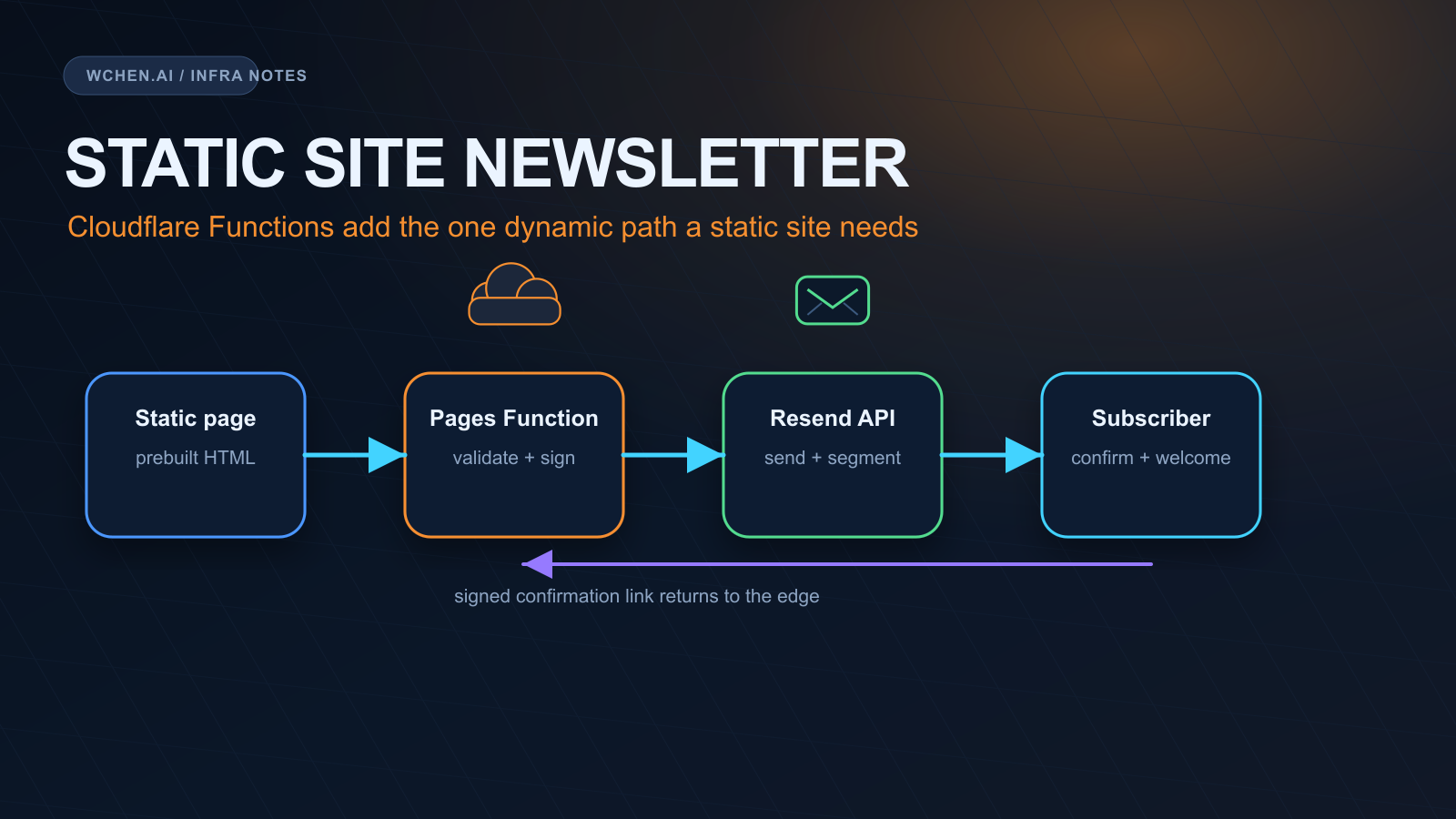
A static site doesn't run code when someone hits a page. That's the point. But a newsletter requires dynamics: accept a signup, send a confirmation email, handle the click, add the contact to a list, send a welcome. So how do you keep the site static and still own the full flow?
I do it with Resend for delivery and Cloudflare Pages Functions for the tiny API surface. The HTML is pre-built and served from the edge. The only code that runs at request time lives in a handful of route handlers that validate input, sign tokens, and call Resend. No server to maintain. No separate backend to deploy.
Where the Work Happens
The site is a Next.js static export on Cloudflare Pages. Every page is a file. When a visitor loads the homepage or a writing piece, they get bytes from the CDN. Nothing executes.
Newsletter signup is different. The form posts to /api/newsletter. That path is not a static file. Cloudflare Pages invokes a Function — the same Workers runtime that backs Pages — and runs the handler in functions/api/newsletter.ts. The handler parses the body, validates the email, builds a signed confirmation link with an HMAC and a timestamp, and calls Resend's API to send the confirmation email. Response back to the client. No database, no queue. Just a few environment variables: RESEND_API_KEY, NEWSLETTER_SECRET, and optionally NEWSLETTER_FROM.
When the user clicks the link, the request hits /api/newsletter-confirm. Another Pages Function. It verifies the signature and timestamp, adds the contact to a Resend segment via their API, and sends the welcome email, again through Resend. Then it redirects to a static "you're confirmed" page. All email copy — subject lines, body text, footer — comes from locale JSON under content/locales/.../site/newsletter.json. The Functions are thin: they load that content, render the email with shared templates, and hand the result to Resend.
Why This Shape
I wanted the site to stay static-first. No Node server, no always-on process. Cloudflare Pages gives me exactly that: static assets plus the ability to run a small amount of server-side logic only when a request hits an API path. The rest of the traffic is pure CDN.
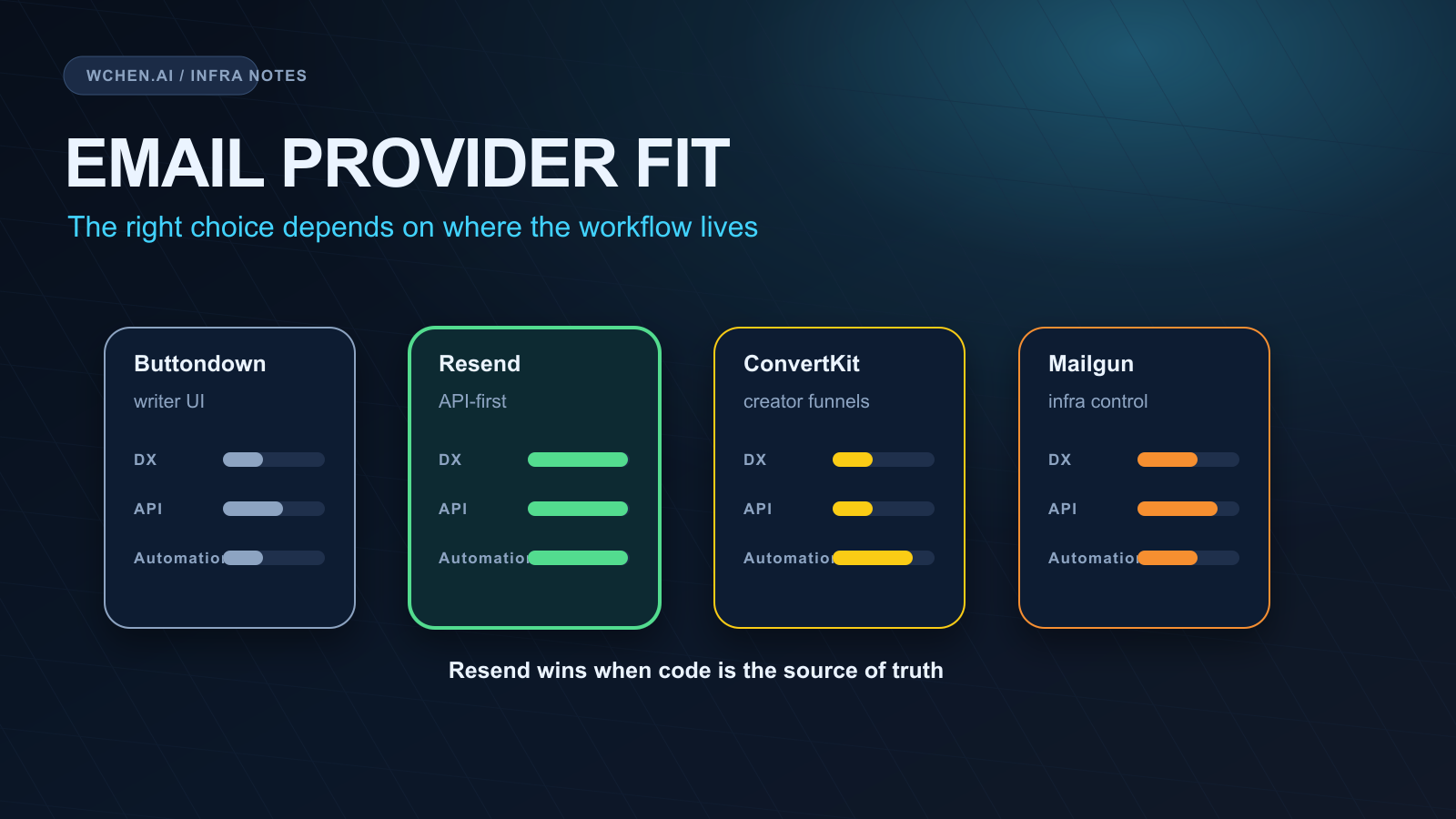
Resend fits because it's API-first. I don't need a dashboard to design campaigns or manage flows. I need to send an email and add a contact to a segment. Both are one HTTP call. The confirmation and welcome emails are composed in code from the same content files the site uses for copy. One source of truth, same deploy.
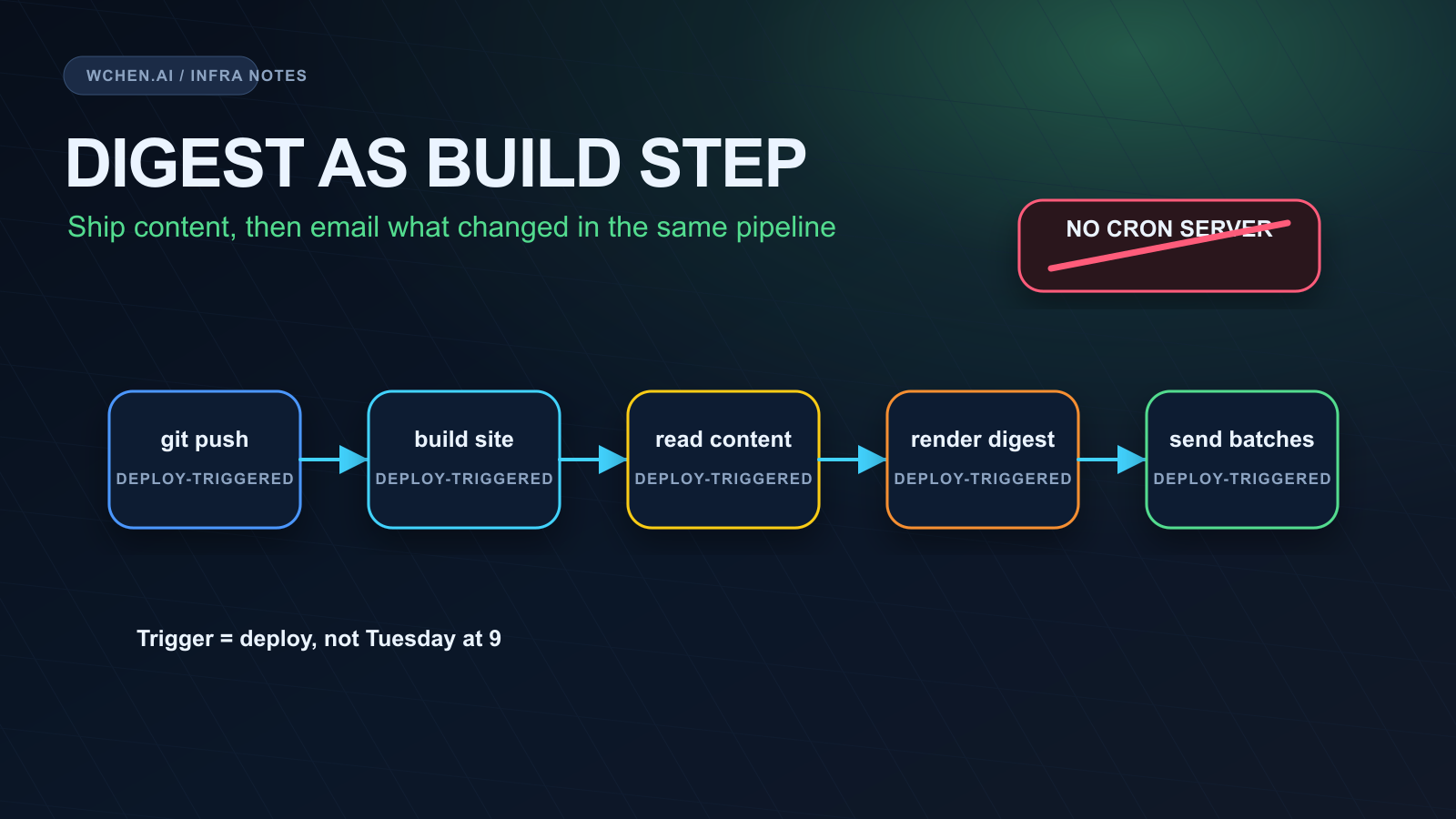
Recurring digest sends — the "here's what's new" email — don't run on the edge at all. A script runs in CI (or locally) after a deploy: it reads the list of published writing and projects, builds a digest, fetches the segment's contacts from Resend, and sends in batches. The script uses the same Resend API and the same content-driven templates. No cron on a server. No Lambda to configure. Just a step in the pipeline that runs when new content is shipped.
The Takeaway
You can have a fully static site and a real newsletter. The dynamic surface is minimal: a few API routes that validate, sign, and delegate to Resend. The platform (Cloudflare) runs those routes at the edge only when they're called. Everything else — pages, copy, templates — lives in the repo and is built once. That's the architecture I want: static by default, with a small, explicit seam for the one thing that has to be dynamic.