My AI Infrastructure Watchlist
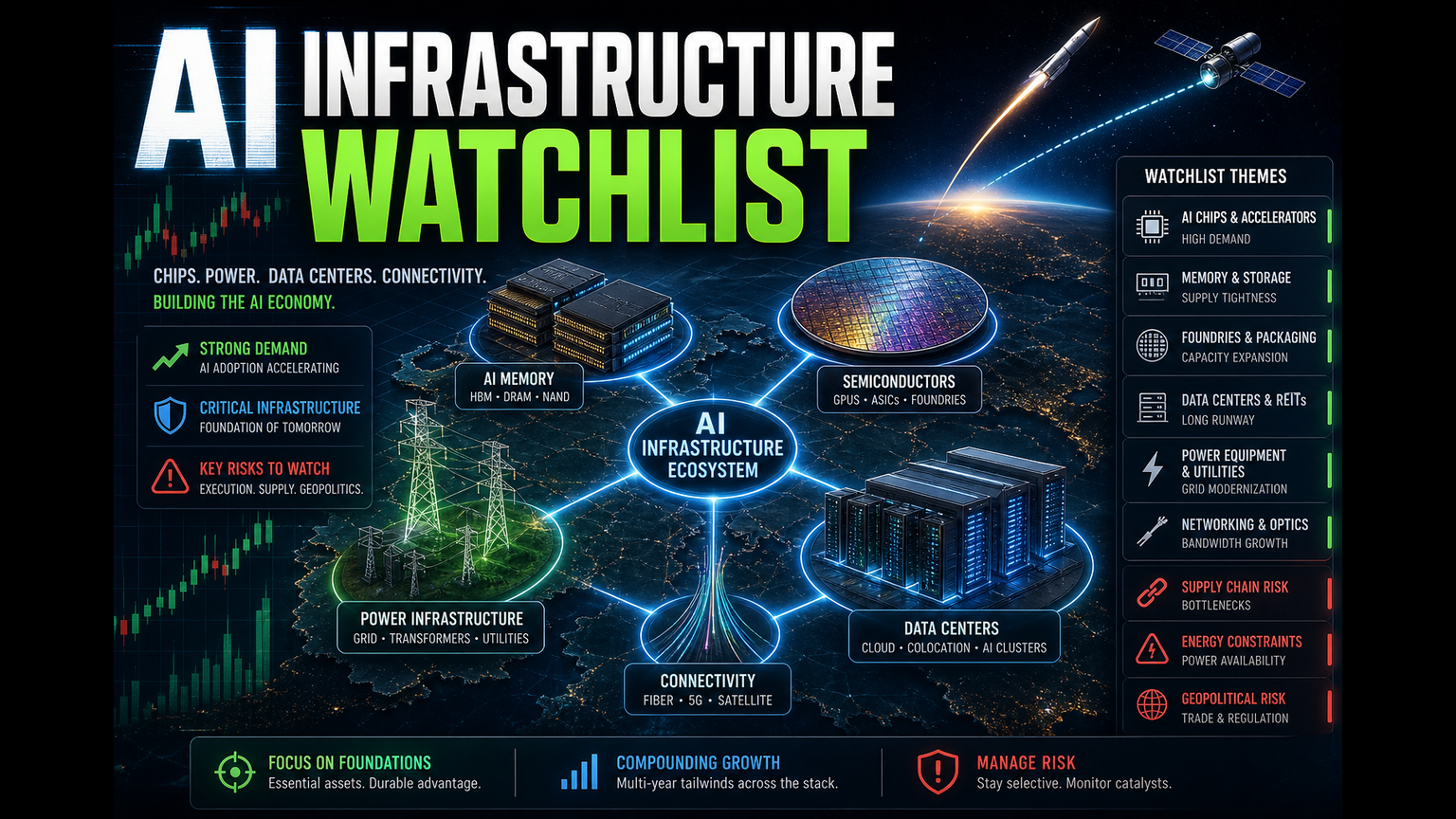
The market theme I keep coming back to is simple: AI is becoming a capacity trade.
For a while, the cleanest story was models, applications, and software adoption. That still matters, but the market is increasingly asking a more physical question: who owns the bottlenecks when intelligence needs memory, chips, fiber, power, cooling, real estate, and eventually more space-based infrastructure?
Nothing here is financial advice. This is a personal watchlist for my own process.
The Market Theme
I do not want to chase every ticker with an AI label.
I want to watch the places where demand runs into physical limits. Memory has cycle risk, but AI workloads are memory-hungry. Semiconductors have valuation risk, but compute still flows through silicon. Data centers have financing and power risk, but the cloud does not expand in the abstract. Space is the most speculative sleeve, but communications, defense, launch, and orbital infrastructure are starting to look less like science fiction and more like another layer of industrial capacity.
That is the frame: not AI as a slogan, but AI as pressure on the real economy.
The Watchlist
This is the current basket I want to keep organized.
| Theme | Tickers | What I Am Watching |
|---|---|---|
| AI memory | MU, SNDK, WDC, DRAM |
Pricing power, high-bandwidth memory demand, storage cycle recovery, and whether earnings revisions keep improving. |
| Semiconductors | SOXL, NVDA, GLW, QCOM |
Compute leadership, semiconductor beta, connectivity, glass and fiber demand, and edge-device AI exposure. |
| Data center | GOOD, AMZN, IREN, CORZ, APLD |
Power access, cloud capex, financing discipline, utilization, and whether infrastructure growth converts into durable cash flow. |
| Space | NASA, RKLB |
Launch cadence, backlog quality, defense demand, satellite economics, and whether the market rewards execution over story. |
The point is not that every name deserves capital at the same time.
The point is that these themes rhyme. They are different expressions of the same question: if AI demand keeps compounding, which parts of the supply chain become scarce, and which companies can turn that scarcity into earnings instead of dilution?
What I Think Is Already Priced In
The market already understands that AI is large.
That means I should assume the obvious winners have less room for lazy thinking. NVDA does not need me to discover that accelerators matter. AMZN does not need me to discover that cloud capex is large. SOXL is not a thesis by itself; it is a volatility instrument tied to the semiconductor cycle.
Where I still see room for work is in the second-order effects.
If training and inference continue to grow, memory becomes more important. If data center buildouts continue, power and specialized real estate matter more. If AI pushes more communications, defense, robotics, and autonomy demand, space infrastructure deserves a place on the edge of the watchlist. The market can price the headline before it prices the bottleneck correctly.
What Would Make Me Add
I want the setup to pass three tests before I add capital.
First, the company needs direct exposure to the bottleneck. I do not want a loose AI story. I want revenue, assets, contracts, or operating metrics that connect to the theme.
Second, the macro tape needs to give permission. If my regime dashboard is red, I should not size speculative infrastructure names like the market is green. The more financing risk a company has, the more the tape matters.
Third, the price needs to respect the risk. Memory and semis are cyclical. Data center names can look cheap before the balance sheet matters. Space can turn into pure narrative if execution slips. A great theme does not rescue a bad entry.
What Would Break The Theme
The simplest invalidation is capex fatigue.
If hyperscalers start pulling back, if memory pricing rolls over, if power constraints make projects less economic, or if financing windows close for infrastructure names, I should treat that as a real warning. This basket has a lot of operating leverage. That works both ways.
I also need to watch for crowding.
When a theme becomes too clean, the market starts paying for the story before the numbers arrive. That is where I can make the most embarrassing mistake: being right about the direction of the world and still wrong about the stock.
The Rule
I am not building this watchlist to predict the next headline.
I am building it so I can compare the same names against the same theme over time. Memory, semiconductors, data centers, and space are all asking one question in different languages: where does the physical world constrain the digital one?
That is the market I want to study now. Not because every ticker on this list is a buy, but because the next durable AI winners may be the companies that turn scarcity into capacity while everyone else is still trading the slogan.